Too Confident or Too Cautious? The Builder-Protector Ratio for Every Stage of Small Business Growth
Some growing companies cannot stop starting things. Others cannot bring themselves to start the one thing that would actually move them.
Both feel like leadership. One is a foot on the gas with no one watching the road. The other is a foot on the brake in a lane that is already moving. Owners in either camp usually blame the team, the market, or their own stamina. The pattern is older than that.
Organizational ReWilding® gives the pattern a name: the Builder-Protector Ratio. After studying more than 1,500 small and mid-sized businesses, The ReWild Group found that every company carries a blend of confidence and caution—and that the healthy blend changes with the Stage of Growth.
Know your stage, and you know how much confidence the company can absorb right now. Miss the ratio, and you can work hard in a climate that cannot hold the work.
What Builders and Protectors Actually Are
The ratio is not a personality test, and it is not a compliment. It measures the overall mindset of the organization: how much confidence it feels, and how much caution.
Builders are the gas pedal. They say yes to new opportunities, tolerate risk, and want to improve how things are done. A sales team often has a high concentration of them. Confidence is useful. Unchecked, it drives the company off the cliff with the accelerator still down.
Protectors are the brake. They have to be persuaded. They prefer tried methods, stable rules, and a slower pace of change. An accounting team often has a high concentration of them. Caution is useful. Unchecked, it suffocates the company and the offerings go stale.
Both want the company to succeed. Neither is the problem. The problem is the wrong blend for the number of people you now have.
People lean one way, but they are not stuck there. Clear language, more structure, and a shared picture of where the company is going can raise caution in a builder or lift a protector’s foot off the brake. That is leadership work, not a hiring purge.
Why the Blend Has to Change
Complexity is driven far more by employee count than by revenue or industry. That is why Organizational ReWilding maps seven Stages of Growth by headcount.
A ten-person company can survive a week of bold experiments. A thirty-person company often cannot. The same confidence that got you out of the garage can traumatize a team that is trying to learn how to work without you in every decision.
Across all seven stages, there is no ideal ratio where Protectors outnumber Builders. Growth needs confidence. In six of the seven stages, confidence should outweigh caution. The one exception is the Delegation Stage, and it is the exception for a reason.
Companies that ignore the ratio tend to do one of two things. They allow more change than the organization can absorb. Or they lack the momentum to leave the stage they are in. Busy, then brittle. Careful, then stuck.
The Builder-Protector Ratio by Stage
Use this as a climate check, not a scorecard. The right ratio is the one your current headcount requires—not the one that matches the founder’s temperament.
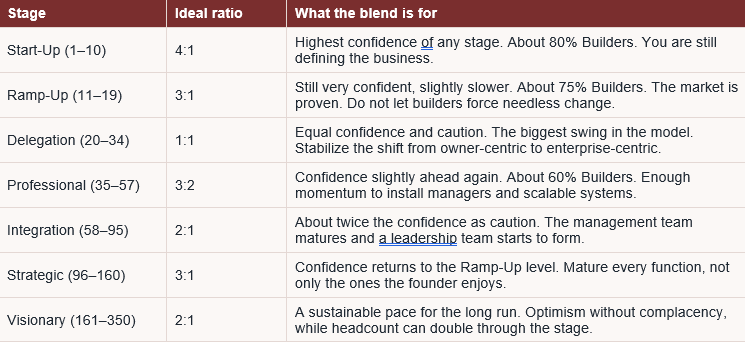
Start-Up (1–10): 4:1. Four times the confidence as caution. This is the tallest builder bar in the model, because the company is still deciding what it is and how it delivers. Setbacks are normal. Belief in the leader is part of the immune system against low morale. Many companies stay here because the organization—or the owner—is too cautious to fund the next experiment. A 4:1 climate is not recklessness. It is the minimum confidence required to get out.
Ramp-Up (11–19): 3:1. Confidence stays high, but the pace of change should ease. You have evidence the market wants what you sell. Profit is still the first Gate of Focus, and that success should reinforce confidence rather than license a new idea every week. Watch the builder who wants to push change the team cannot absorb. Structure is how you temper that, not a speech about slowing down.
Delegation (20–34): 1:1. This is the most significant change in the ratio, which is one reason the crossing feels so hard. The company is leaving an owner-centric model. The leader can no longer see every job. If confidence stays at the Ramp-Up level, growth outruns infrastructure: quality slips, deadlines move, and the owner jumps back into the work. Equal caution is what lets managers form and delegation become real. Over-correct into pure protection, though, and momentum dies. The point is balance, not a freeze.
Professional (35–57): 3:2. The foot goes back toward the gas, carefully. Confidence is only slightly ahead of caution. That measured climate is what a process-heavy stage needs: professional managers, master processes, and interdepartmental planning. A return to Start-Up bravado here skips the infrastructure later stages will bill you for.
Integration (58–95): 2:1. Twice the confidence as caution. The management team should be maturing, and a leadership team should be forming—the people who will eventually run daily operations. Intentional change is back on the table. One protector in a key seat can still halt the advance. The safeguard is not to silence caution. It is to keep it from outvoting the stage.
Strategic (96–160): 3:1. Confidence returns to the Ramp-Up level, for a different job. The company has to mature every function at once, absorb a large wave of new people, and trust a leadership team with the day-to-day. Recruiting and onboarding become part of the climate. A company that reaches this size without an integrated management team will struggle to feel this confident, and the struggle will look like strategy when it is really missing structure.
Visionary (161–350): 2:1. A slight easing from Stage 6, on purpose. Growing through this range can double the company, and that takes time. The climate should stay optimistic enough to keep innovating and cautious enough not to become complacent. Shared language, values, and a leadership team that people actually experience are what hold a 2:1 blend at this size. The founder’s personal energy no longer can.
What Goes Wrong When the Climate Is Off
Misalignment is easy to admire, because both failure modes look like virtues.
Too many Builders. The company chases the next offer before the current one is clear. Critical thinking gets skipped on the way to execution. Revenue may rise while quality, cash, and the team’s ability to absorb change fall behind. Some companies grow themselves out of business.
Too many Protectors. The company misses the window. Offerings go stale. People confuse stability with safety. Growth slows, then retreats. In Stage 1 this often looks like a careful owner surrounded by careful people, waiting for certainty that the stage will never provide.
Last stage’s confidence, this stage’s headcount. The classic version is a Delegation-stage company still running a 3:1 or 4:1 climate. The owner calls it entrepreneurial. The team experiences it as chaos. Owner dependency deepens, because no one else can keep up with the pace of change.
A protector in the seat that sets the climate. One cautious leader, especially in Stage 5 or 6, can outweigh a building team. The ratio is organizational, but influence is not evenly distributed.
None of those owners were careless. They kept a strength past the point where it was the strength the company needed.
How This Fits the Rest of the Map
If you have been following the series, the pieces now stack.
The seven stage posts tell you the chapter. Transition Zones tell you why the crossing feels chaotic. The Gates of Focus tell you where to put energy this month—People, Profit, or Process. The Builder-Protector Ratio tells you the climate that energy needs in order to land.
A Profit-first Start-Up still fails if the climate is too cautious to pursue the revenue. A People-first Delegation Stage still fails if the climate is too confident for managers to form. Process work in the Professional Stage needs a 3:2 blend: enough confidence to install new systems, enough caution not to rip them out next month.
The ratio also answers a false choice owners hear constantly. “Be bold” and “be careful” are both incomplete. The research-based question is narrower. Bold compared with what, and careful for which headcount?
What to Do This Week
You do not need a culture offsite. You need an honest read on the climate.
Count full-time equivalent employees and name your Stage of Growth. The ratio follows headcount, not how ambitious the year feels.
Write the ideal ratio where you make decisions. If you are in Delegation, write 1:1 in plain language: equal confidence and caution until managers can carry the work.
Look at the last five meaningful decisions. How many were gas, and how many were brake? Compare that with the ratio, not with your preference.
Name the natural lean of the people closest to the work. Do not use it as a label. Use it to see whether one mindset is quietly setting the climate.
If confidence is high for the stage, add structure. Point sales at the core offer instead of the next new one. Say what will not change this quarter.
If caution is high for the stage, paint the destination. Protectors do not need a pep talk. They need a clear picture and a reason to trust it.
If you are also in a Transition Zone, hold the ratio even more tightly. Rough water is a bad time to hire a wave of builders as a substitute for design.
Ready to Check the Climate?
The Builder-Protector Ratio only helps if it matches the company you have, not the company you remember founding or the one you hope you have already become.
Start with the free Stage Calculator. Then pick up the 60-minute guidebook for your current stage—each one includes the Builder-Protector Ratio, the Gates of Focus, the Non-Negotiable Rules, and the Transition Zone you are heading into: the stage guidebook series.
If you want the one-page ratio for every stage, the Builder-Protector Ratio Packet covers what the right blend looks like and what happens when it is off.
The earlier posts in this series:
Gates of Focus: People, Profit, or Process — where to put energy once you know the stage.
Transition Zones: Flood Zones and Wind Tunnels — why the crossing feels harder than the stage itself.
And the stage underneath the ratio:
Confidence is not a personality you either have or do not. Caution is not a failure of nerve. At each stage, one blend lets the company absorb the right amount of change. Lead for that blend, and the next stage stops feeling like a character test.