What Really Happens in the Strategic Stage (96–160 Employees) and How to Plan Beyond Next Quarter
If your company has crossed roughly a hundred people, operational excellence is no longer the scarce resource. You probably already have departments, managers, and a leadership team that can run the week. What starts to feel scarce is the future: a plan longer than the next quarter, a culture that still holds as new names keep appearing, and a CEO role that is no longer “chief firefighter.”
You’re not losing your edge. You’re in the Strategic Stage of Organizational ReWilding®—Stage 6 of seven predictable stages every growing company moves through.
After studying more than 1,500 small and mid-sized businesses, The ReWild Group found that complexity is driven far more by employee count than by revenue or industry. Stage 6 (96–160 employees) is where a company that grew on strong teams and solid operations has to become genuinely strategic—or get outpaced by larger competitors and hungrier smaller ones.
What the Strategic Stage Actually Looks Like
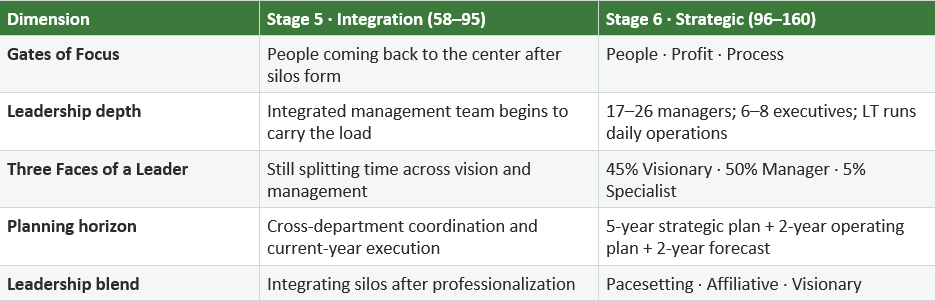
A Stage 6 company typically has 17–26 managers and six to eight executives. The leadership team should be running day-to-day operations. The CEO’s job is to manage that leadership team and cast a vision that can travel through several layers of people.
The dominant realities:
People become the highest Gate of Focus, ahead of Profit and then Process. At this size, new hires will not absorb culture by sitting near the founder. Assimilation has to be designed.
Profit stays second. The revenue engine should already be reliable. The work now is protecting margins at a higher level of complexity.
Process is third—not optional. Process was the primary Gate in the Professional Stage (35–57). If you skipped that investment, Stage 6 will expose it.
The ideal Builder-Protector Ratio returns to 3:1. The company needs high confidence to mature every function at once, not just the ones the founder enjoys.
Your time mix shifts to roughly 45% Visionary, 50% Manager, and 5% Specialist. And “Manager” now means managing leaders who manage managers—not jumping back into the work.
The leadership blend that fits this stage is Pacesetting first, Affiliative second, and Visionary third. You set the performance bar, you keep people from feeling like a number, and you give the company a future worth staying for.
The Classic Challenges You’ll Almost Certainly Face
Owners and CEOs in the Strategic Stage commonly wrestle with five predictable challenges:
Hiring quality people. You may be two or three times the size of the last stage, and the labor market does not care that your plan requires it.
Ineffective new-staff orientation. People join, stay confused, and never quite become “one of us.”
Lack of staff buy-in. The gap between the CEO and a new employee has never been wider. Vision dies in that gap unless leaders carry it.
Staff satisfaction not linked to company success. People can like their team and still be indifferent to profit.
A weak business model. What got you here will not automatically win the next five years.
These are not proof that the culture “isn’t what it used to be.” They are stage dynamics. Organizational ReWilding treats the business as a living ecosystem: at each stage certain elements are missing. Infusing Brand & Core Values, a Strong Management Team, Organizational Structure, Master Processes, and a living Business Model restores balance.
Practical Rules That Move You Forward
The Stage 6 Non-Negotiable Rules are the research-based must-dos before you try to graduate into the Visionary Stage (161–350 employees). Aim to be at least 80 percent complete with them.
Build a real planning stack, not a binder. Overhaul the business model with the leadership team. Produce a 5-year strategic plan and a 2-year operational plan. Add a 2-year forecast by revenue group and customer segment. Review margins quarterly.
Make Business Development one team. Marketing, sales, and customer service should win together on a synergistic strategy, using an integrated CRM—not three scorecards that argue with each other.
Install the financial system Stage 7 will need. Don’t wait until you have 200 people to discover the books cannot support the company you are becoming.
Let the leadership team run the company. Leaders and managers demonstrate Core Values daily. If the business still needs you in the daily details, you do not yet have a Stage 6 leadership team.
Challenge operations to get cheaper and more scalable. Departments should identify, acquire, and implement advanced processes and systems that lower cost without lowering quality.
Treat culture as infrastructure. Revitalize onboarding so new hires are immersed in culture and process. Run an annual organizational health survey. Hold at least one company-wide unifying event a year.
The Wind Tunnel Into Stage 7
The jump from Stage 6 to Stage 7 is another Wind Tunnel: systems that worked at 120 people start to fail at 160. The common mistake is to blame growth itself—the new hires, the new vendor, the new office—rather than the scalability of the design.
When the water gets rough, lead with Structure, Clarity, and Focus. Tell people what is changing. Replace what no longer scales. Do not add headcount as a substitute for a better system. Adding people to a Flood Zone only adds complexity.
How This Stage Sets Up the Visionary Stage
Stage 6 is where the company learns to think in years instead of weeks. Stage 7—the Visionary Stage—asks the leader to spend most of their time on the future and to recapture the entrepreneurial spark that made the early years possible.
If Strategic is done well, Visionary does not feel like a midlife crisis. You already have a leadership team that runs the present. You already have a planning cadence. Culture has a pulse you can measure. Then the work can shift from “How do we keep this together?” to “What should we become next?”
A Quiet Warning About the Most Common Mistake
The most expensive Stage 6 mistake is staying operationally brilliant and strategically thin. The leadership team runs a tight week. Customers are served. And nobody owns the five-year question. Meanwhile culture thins out because onboarding is still “follow someone around for a few days.”
You cannot paceset 150 people in person. You can paceset a leadership team, give them a plan, and insist that Core Values show up in hiring, orientation, and one-to-ones. That is the work.
What to Do This Week
You do not need a new offsite theme. You need to see whether the future has an owner.
Ask, honestly: does the leadership team run the company without you in the daily details?
Put dates on a business-model overhaul, a 5-year strategic plan, and a 2-year operating plan—even if the first drafts are imperfect.
Walk the last five new hires through their first 30 days and write down where culture and process failed to transfer.
Schedule one company-wide unifying event in the next twelve months. Unity at this size is not a vibe. It is a design choice.
Ready for the Full Roadmap?
If the present is stable and the future still feels improvised, you are not behind. You are exactly where Stage 6 companies land before they become strategic on purpose.
Organizational ReWilding gives you a research-based map instead of another generic planning template. Start with the free Stage Calculator. Then pick up The Strategic Stage: Organizational ReWilding® Rules for Business Growth—the 60-minute guide written for owners at 96–160 employees.
When the planning stack is in place, the Visionary Stage is next: same company, larger complexity, and a new assignment—keep the entrepreneurial spirit alive so stability does not become stagnation.
Growth at this size is not about doing more. It is about giving a hundred-plus people a future they can see themselves in—and a leadership team that can carry it when you are not in the room.