Small Business Growth Stages: What Really Happens in the Ramp-Up Stage (11–19 Employees) and How to Keep Growing Without Stalling
If your team has grown past ten people, the business that used to run on energy and improvisation is starting to feel heavier. Jobs still get done, but quality is less consistent. New hires take longer to get up to speed. You are still the person everyone comes to—and the calendar no longer has room for that.
You’re not failing. You’re in the Ramp-Up Stage of Organizational ReWilding®—Stage 2 of seven predictable stages every growing company moves through.
After studying more than 1,500 small and mid-sized businesses, The ReWild Group found that complexity is driven far more by employee count than by revenue or industry. Stage 2 (11–19 employees) is the last owner-centric stage. Profit is still the top priority, but process has to move up the list. If you keep running Stage 2 with Stage 1 habits, growth stalls—or slides backward.
What the Ramp-Up Stage Actually Looks Like
In Stage 2 the business is still built around you, but it has gained enough people that informal coordination is no longer enough. You need more structure, clearer roles, and a handful of supervisors who can carry part of the load.
The dominant realities:
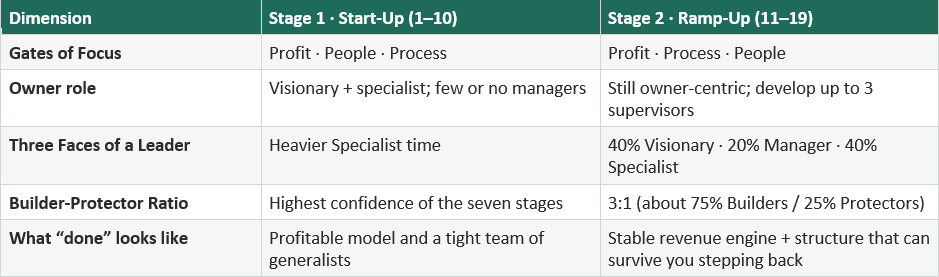
Profit remains the highest Gate of Focus. You still need enough profitable revenue to fund the next layer of people and systems.
Process moves into second place—ahead of People. With 11 to 19 employees, chaos that used to be “just how we work” now drives good people away.
Hiring shifts from versatile generalists toward more specialized talent, even while the team is still small.
You should be developing up to three supervisors who are responsible, accountable, and proactive. They are the bridge to the management team Stage 3 will require.
The ideal Builder-Protector Ratio is 3:1—still a high-confidence culture, but slightly more measured than Stage 1, because the same pace of change now affects twice as many people.
A useful picture of your own time: in Stage 2 the research points to roughly 40% Visionary, 20% Manager, and 40% Specialist. You are still in the work. You should not still be doing all of the work.
The leadership blend that fits this stage is Coaching first, Pacesetting second, and Commanding third. You develop people, you set the performance standard by example, and you still make the calls that keep the company moving.
The Classic Challenges You’ll Almost Certainly Face
Owners in the Ramp-Up Stage commonly wrestle with five predictable challenges:
Hiring quality people. Roles are still fuzzy, and you are hiring more specialists than you did at ten employees.
Inadequate sales. Word-of-mouth that carried Stage 1 is no longer a reliable engine.
A leadership–staff gap. You are still making most of the decisions while the team waits.
Limited capital to grow. Headcount has risen faster than cash discipline.
Weak cash flow. Payroll is now a real monthly test, not a rounding error.
These are not personal failings. They are stage dynamics. Organizational ReWilding treats the business as a living ecosystem: at each stage certain elements are missing or underdeveloped. Infusing the right ones—Brand & Core Values, clearer Organizational Structure, Master Processes, a basic One-to-One Process, and the start of a Strong Management Team—restores balance.
Practical Rules That Move You Forward
The Stage 2 Non-Negotiable Rules are the research-based “must-dos” before you try to graduate into Delegation (20–34 employees). Aim to be at least 80 percent complete with them.
Protect profitable revenue with more structure, not more hustle. Organize marketing, sales, and customer service around three customer segments. Identify the brand values that are your promise to the market. Sell every day. Review margins quarterly by revenue group and customer segment so you know which work actually funds growth.
Make money visible to the whole team. Every employee should contribute to at least one KPI. People need to understand how the company makes and keeps money. When that connection is missing, morale drops and spending creeps up.
Develop three supervisors—on purpose. Do not wait until you “feel ready” to let go. Coach two or three people to own outcomes, not just tasks. Put directions in writing so a growing team can stay aligned without another meeting with you.
Clarify roles and organize the work. Drive small action teams that hit goals. Organize operations around your three revenue groups. Start specializing roles instead of asking everyone to do everything.
Name the culture before it drifts. Identify Core Values that establish the company’s promise to the team. The culture that felt obvious at eight people will not automatically transfer to eighteen.
Watch the Transition Zones—They Explain the Turbulence
Growth is not a smooth ramp. Around eight to twelve employees you are typically in a Flood Zone: leaving Stage 1 and arriving in Stage 2 at the same time. From about thirteen to seventeen employees you enter a Functional Zone, where the Stage 2 rules can actually take hold. Near the top of the range, the next transition begins.
The move from Stage 2 into Stage 3 is a Wind Tunnel. Systems that worked when everything still ran through you stop being sufficient. That is not a sign you built the wrong company. It is a sign the company has outgrown an owner-centric design.
When you are in a transition, lead with Structure, Clarity, and Focus. Tell the team what is changing. Narrow new initiatives. Make roles unmistakable. Confidence holds when people can see the map.
How This Stage Sets Up Everything That Follows
Stage 2 is the last chapter of “the business is me.” Stage 3—the Delegation Stage, 20–34 employees—is the first enterprise-centric chapter. The shift is one of the hardest owners ever make.
If you use Ramp-Up well, Delegation gets easier. You already have supervisors in motion. Roles are written down. Revenue is organized, not accidental. Cash is watched. Culture has a language. When it is time to reduce owner dependency in a serious way, you are not starting from zero.
If you skip the structure and try to grow on personality alone, Stage 3 feels like betrayal: the business you built no longer fits the way you work. That pain is optional. The rules exist so you do not have to learn it the expensive way.
A Quiet Warning About the Most Common Mistake
The most expensive Ramp-Up mistake is celebrating the people you already have by adding perks, equipment, and overhead before the revenue engine is stable. Morale ticks up. Payroll gets tighter. Growth plateaus. Then the owner goes back into specialist mode to “save the month,” and owner dependency deepens.
Reward the team—after the margins can carry it. In this stage, generosity without a profit-first Gate of Focus is how good companies stall.
What to Do This Week
You do not need a reorganization. You need one honest look at where the load still sits.
Write down the three customer segments and three revenue groups you actually serve—not the ones you wish you served.
Name the two or three people who could become supervisors in the next 90 days, and give each one a written outcome to own.
Put one repeating direction in writing this week instead of repeating it in person.
Look at cash and margins by segment, not just the top-line number.
Those four moves are small. Together they are how a Stage 2 company stops depending on the owner’s memory.
Ready for the Full Roadmap?
If the business feels bigger than the system holding it, you are not alone—and you do not have to guess what comes next. Organizational ReWilding gives you a research-based map instead of another set of generic best practices.
Start with the free Stage Calculator at rewildgroup.com/stage-calculator. Then pick up The Ramp-Up Stage: Organizational ReWilding® Rules for Business Growth—the 60-minute guide written specifically for owners at 11–19 employees. It walks through the Gates of Focus, Builder-Protector Ratio, Leadership Style Blend, Three Faces of a Leader, Non-Negotiable Rules, Classic Challenges, and Transition Zones, with application questions you can use immediately.
When you are ready for the next chapter, the Delegation Stage (20–34 employees) is where owner dependency is confronted directly. Ramp-Up is how you arrive there prepared.
Growth does not have to mean more burnout. In Stage 2 it means a business that can generate profitable revenue on purpose, with a little more structure and a few more leaders than you needed at ten people.
You’ve already proven there is a market. Now build the organization that can keep the promise without you standing in every gap.