
What Really Happens in the Visionary Stage (161–350 Employees) and How to Stay Innovative Without Going Stale
If the company now has a couple hundred people, a leadership team, and a planning cadence, congratulations—you have done what most businesses never do. The danger hiding inside that success is quiet. Stability starts to feel like the goal. Offerings age. Margins soften. The entrepreneurial spark that built the place gets professionally managed out of the building.
You’re not ungrateful for what you’ve built. You’re in the Visionary Stage of Organizational ReWilding®—Stage 7 of seven predictable stages.
After studying more than 1,500 small and mid-sized businesses, The ReWild Group found that complexity is driven far more by employee count than by revenue or industry. Stage 7 (161–350 employees) is less about surviving chaos and more about refusing irrelevance. A visionary leader is useful in every stage. In this one, vision is the job.
What the Visionary Stage Actually Looks Like
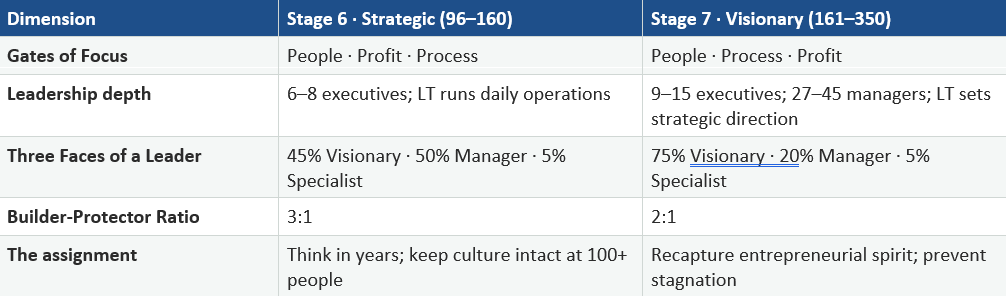
A Stage 7 company typically has 27–45 managers and 9–15 executives. The leadership team should already run the present. The CEO spends most of the week on the future—and on the two or three leaders who could one day take the chair.
The dominant realities:
People remain the highest Gate of Focus, then Process, then Profit. You cannot personally know everyone. You can still walk the floor. And you must grow a leadership team that makes employees feel known.
Process moves into second place. Quality and innovation both depend on methods that can handle twice or three times the headcount of Stage 6.
Profit drops to third—not because money stopped mattering, but because a company this size should already have a working profitability engine. If it doesn’t, Stage 7 will feel expensive fast.
The ideal Builder-Protector Ratio eases to 2:1. Still confident, a little more measured. Doubling through this stage takes time; reckless change creates trauma.
Your time mix becomes 75% Visionary, 20% Manager, and 5% Specialist—the most concentrated Visionary allocation in the entire model.
The leadership blend that fits this stage is Visionary first, Coaching second, and Democratic third. You ignite innovation, you grow future leaders, and you listen—because the next offering is often already living in someone else’s head.
The Classic Challenges You’ll Almost Certainly Face
Leaders in the Visionary Stage commonly wrestle with five predictable challenges:
Inadequate profits. Revenue can still rise while the money available to reinvest quietly disappears.
A marketplace that is changing faster than the company. What used to be “our market” starts to move without asking permission.
Products or services that are no longer differentiated. Yesterday’s advantage became table stakes.
Slow getting offerings to market. Process that once created quality now creates delay.
A weak or stale business model. Past success is the most convincing argument for doing nothing.
These are not signs that the company “got corporate.” They are the symptoms of an ecosystem that has enough structure to survive and not enough vision to stay alive. The missing elements are usually a refreshed Business Model, stronger Business Development, living Core Values, and a Leadership Team that still touches customers.
Practical Rules That Move You Forward
The Stage 7 Non-Negotiable Rules keep a stable company from going stale. Stay at least 80 percent complete with them if you want to grow through this stage rather than coast inside it.
Put the leadership team in the market every day. They should keep a pulse on customer needs and confirm that offerings are still attractive. Strategy that never hears a customer becomes a slide deck.
Revitalize the business model on purpose. Optimize margins. Rethink revenue groups and customer segments. Innovate new offerings. The leadership team—not only the founder—sets future strategic direction.
Keep cash and contribution visible. Generate, track, and preserve cash. Every employee contributes to a KPI. Everyone should still know how the company makes and keeps money.
Walk around—and name successors. The leadership team practices management by walking around and interacts with people as people. Select two or three leaders in the succession line and train them for the CEO role.
Run operations like a long-term asset. Hold production capacity utilization between 75 and 85 percent. Set a 3-year capital investment plan so you are not surprised by the cost of staying competitive.
Innovate the culture, don’t just protect it. Refresh the Core Values program. Introduce a citizenship reward program. Keep investing in people (the research points to about 3% of gross revenue for development, including the health survey and the annual unifying event).
What Happens After 350 Employees
Beyond Stage 7, companies often begin operating as a collection of units, each with its own complexity. A Western Division with 120 people is living Stage 6 rules. An Engineering group of 45 is living Stage 4 rules. The map does not expire. It starts applying at the unit level.
That is why Stage 7 succession work matters so much. You are not only replacing a CEO. You are preparing leaders who can diagnose stage, not just manage functions.
How the Earlier Stages Made This Possible
Visionary is not a personality type. It is a stage you earn. Start-Up and Ramp-Up proved the market. Delegation made the company less owner-centric. Professional and Integration built managers and then connected them. Strategic created the planning stack and a leadership team that can run the week.
Skip those infusions and Stage 7 looks like a founder giving speeches while the middle of the company improvises. Do them, and vision has a place to land.
A Quiet Warning About the Most Common Mistake
The most expensive Stage 7 mistake is confusing stability with health. The company is profitable enough. Customers still buy. Meetings run on time. And the offerings that built the brand are slowly becoming interchangeable.
A Visionary-stage CEO who stays buried in specialist work—or who never names a successor—teaches the organization that the future is optional. It is not. Markets move. People leave. The business model that is not revitalized becomes the one competitors quietly replace.
What to Do This Week
You do not need a new slogan. You need contact with the market and a name on the succession list.
Block time this week for the leadership team to sit with customers, not only with dashboards.
Ask which offerings are still differentiated—and which ones the market now treats as default.
Write down two or three leaders who could become CEO, and give each a development assignment that is bigger than their current function.
Walk a floor, a job site, or a branch you have not visited in a while. People are still the top Gate of Focus. They should be able to feel it.
Ready for the Full Roadmap?
If the company is stable and a little too quiet, you are not imagining it. Stage 7 is the stage where healthy businesses either renew themselves or slowly become the case study someone else uses.
Organizational ReWilding gives you a research-based map instead of another inspiration offsite. Start with the free Stage Calculator at rewildgroup.com/stage-calculator. Then pick up The Visionary Stage: Organizational ReWilding® Rules for Business Growth—the 60-minute guide written for leaders at 161–350 employees.
And if a unit inside the company is smaller than the whole, diagnose that unit by its own employee count. The seven stages still apply—just closer to the work.
You already built something that lasts. The Visionary Stage is how you make sure it still matters.