
The ReWild Group Blog
Your home for relevant and engaging content serving small business owners and consultants. Subscribe so you don’t miss a post!

What Is a Professional Stage Business (35-57 Employees)? The Critical Transition Most Owners Miss
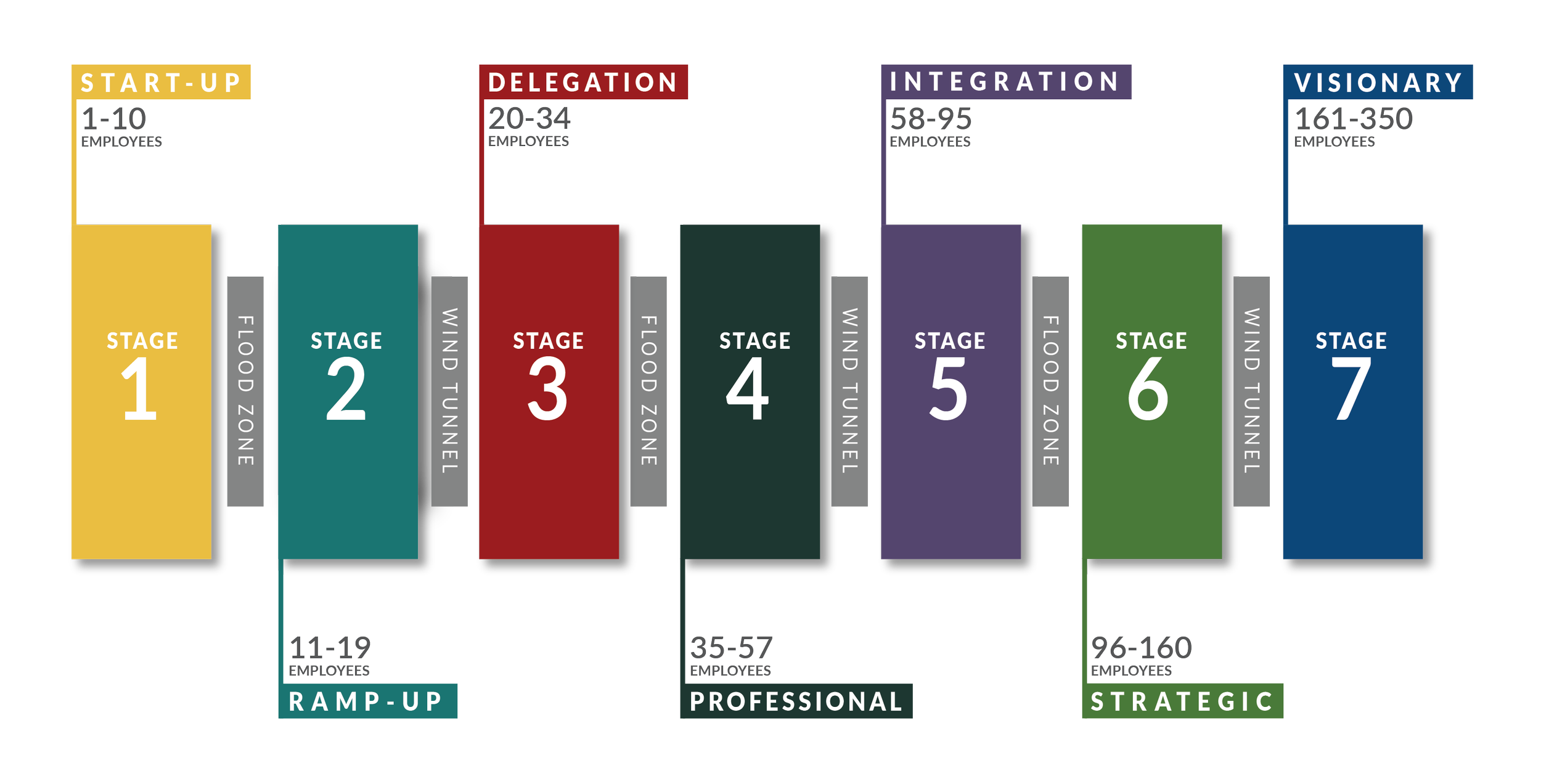
If your small or mid-sized business has grown to 35-57 employees, congratulations—you’ve reached the Professional Stage (also known as Stage 4 in the Organizational ReWilding® framework).
This is one of the most pivotal and challenging phases of growth. The chaos of the early years has settled into something more structured, but new complexities emerge that can stall progress or push you back into burnout if not handled correctly.

Organizational ReWilding® vs. Pinnacle
Integrated Operating Models vs. Adaptive Structures: Planning for Growth vs. Designing for Complexity
As SMBs mature, leadership teams often find themselves searching for a system that brings together strategy, execution, and leadership development into a more cohesive whole.
Early-stage growth can tolerate a certain amount of informality.
But as headcount increases and departmental responsibilities expand, success becomes more dependent on whether the organization is operating from a shared model of how work—and leadership—should function.
This is where integrated operating frameworks can play an important role.

Organizational ReWilding® vs. Scaling Up
Execution Alignment vs. Managerial Design: What Happens After the Priorities Are Clear?
For many growing SMBs, one of the most important early breakthroughs is learning how to align execution across the leadership team.
Once a company moves beyond the founder-does-everything phase, success becomes less about individual effort and more about whether teams are working toward the same priorities—at the same time, in the same way.
That’s where execution frameworks can make an immediate impact.
Rules for Business Growth at Different Stages: A Roadmap to Sustainable Scaling
Growing a small or mid-sized business isn't about random tactics or endless hustle—it's about following proven rules that evolve as your company does. Many owners make the mistake of applying the same strategies from their early days to later stages, only to hit plateaus, chaos, or burnout. The truth is, each phase of growth has its own set of "rules"—non-negotiable principles that, when followed, make scaling smoother, more profitable, and less owner-dependent.

Organizational ReWilding® vs. Predictable Success
Lifecycle Awareness vs. Structural Readiness: Why Knowing Your Stage Isn’t the Same as Designing for It
As small and mid-sized businesses grow, most leadership challenges don’t emerge all at once.
They arrive in patterns.
Communication becomes more fragmented.
Decisions take longer than they used to.
Managers spend more time “in the work” and less time coordinating it.
Founders feel pulled back into responsibilities they thought they had already delegated.

ReWilding’s Flexibility vs. EOS’s Exclusivity: A Comparison for Advisers
For business consultants and advisers, the choice between Organizational ReWilding and the Entrepreneurial Operating System (EOS) centers on a fundamental difference: ReWilding’s non-exclusive framework allows advisers to draw on past experience, integrate other systems, and adapt to unique client needs, while EOS demands strict adherence to its proprietary methodology.

When Advisers Over-Customize Client Solutions
Management consultants, strategy advisers, organizational development specialists, and leadership coaches often face a common challenge: over-customizing solutions for small and medium-sized businesses (SMBs). While tailoring solutions feels like the right approach, it can lead to burnout, inefficiency, and missed opportunities for scalability.

Two common mistakes that stop sales
As the second step in the business development process, sales is the function responsible for turning leads into revenue. It’s an important part of every business, large or small. Without revenue (or donations, depending on your business model), you don’t have the resources you need to keep your doors open and continue providing the same high-quality products or services.
Sales professionals have the benefit of extensive training, but not many small business owners have that luxury. As with so many other aspects of business, the small business owner improvises, learns on the job, and picks up resources whenever possible.

Business Consultants: Are you having the impact you want?
Business consultants and advisers want to have an impact on their clients. The whole reason most of them get into consulting is to make a difference—to use their knowledge and experience to help business owners thrive. A common frustration we hear from consultants, though, is that they aren’t able to make the significant progress they’d like to. They don’t get the opportunity to go deeply enough with a client to make a significant, long-term impact.

How to tell a business owner what’s wrong with their business.
There’s no getting around it. It’s awkward. You’re face-to-face with a business owner who has poured time, energy, and effort into running a business. Things aren’t going well, which is why you were hired in the first place. And yet, even though your advice was solicited, you hesitate to share your findings with the business owner.
While we can’t get rid of all the unpleasant confrontations that may arrive throughout the course of work for business advisers, we do have some advice for anyone looking for a better way to deliver tough news.

How to sell consulting services to small business owners
In our previous post, we focused on ways to successfully market yourself as an adviser to small business owners. In this article, we’re going to talk about how to sell to small business owners.
To clarify, and make sure we’re all on the same page, marketing and sales are two distinct functions of a business. The purpose of marketing is to generate leads, while the purpose of sales is to convert those leads into revenue.

How to market consulting services to small businesses
As a small business consultant, you have a wealth of information and years of experience. You’re also keenly aware that there are many businesses in need of help. The question is … how do you reach them? How do you hold their attention long enough to explain what you do? To help you make the most of your time and effectively raise awareness of your services, we’ve put together three tips on how to market to small business owners.

Structure, Clarity, and Focus
One of the phrases that is often used in the Organizational ReWilding® methodology is “Structure, Clarity, and Focus.” While not a key element package, these important concepts underpin many of the principles and lessons that are part of the methodology. The purpose of this article is to take a closer look at what makes this phrase so meaningful—first by defining each term in the phrase and then connecting them to specific key elements.

What are the Stages of Growth?
The Organizational ReWilding Stages of Growth, formerly known as the 7 Stages of Growth, is a business growth methodology based on the distinct stages businesses grow through. Each Stage has rules of growth, which if followed, create the environment for sustainable, profitable growth.

Scaling Up and Organizational ReWilding
How Organizational ReWilding, a business growth methodology, and Scaling Up, a curated platform organized by decision points, are helping leaders of small and midsized businesses.

What is the difference between EOS® and Organizational ReWilding?
How Organizational ReWilding, a business growth methodology, and EOS, an entrepreneurial operating system, are helping leaders of small and midsized businesses.

Value Builder and Organizational ReWilding
How Organizational ReWilding, a business growth methodology, and The Value Builder System, a business valuation tool, are helping leaders of small and midsized businesses.

The 7 Stages of Business Growth
Over a decade ago, James Fischer published the book, Navigating the Growth Curve, in which he presented a groundbreaking methodology for understanding how businesses grow. Based on decades of research and observation of small and mid-sized businesses, Fischer discovered how the complexity of an organization drives the rules by which a business must operate to continue to grow.