
Making the First 90 Days After Buying a Business “Decisively Boring”
Why the smartest new owners are installing a proven operating system instead of crossing their fingers.
You did it. After months (or years) of searching, due diligence, negotiations, and financing gymnastics, the deal is closed. The business is yours.
The champagne is poured. The seller smiles, shakes your hand, and walks out the door—taking with them years of hard-won intuition, undocumented workarounds, customer relationship nuances, and “the way we actually do things around here.”
Now what?
For too many first-time buyers and ETA entrepreneurs, the weeks and months that follow are not the triumphant ramp-up they imagined. They’re a blur of operational fires, cash flow surprises, confused team members, and the sinking realization that tribal knowledge just left the building.
The first 90 days after acquisition are widely recognized as the most critical—and most dangerous—period for new ownership. This is when businesses either stabilize and build momentum… or quietly fracture in ways that are hard to recover from.

The Reality Most Buyers Discover Too Late
The excitement of closing on your own business is hard to overstate. After months or years of searching, analyzing CIMs, negotiating, securing financing, and imagining the future, the ink dries and the keys (figuratively or literally) are in your hands. But for too many first-time buyers and Entrepreneurship Through Acquisition (ETA) entrepreneurs, the weeks and months that follow reveal a much harsher reality than the polished financials and optimistic projections suggested.
Here’s what actually happens in those critical early days for many new owners:
The Tribal Knowledge Vacuum
The seller walks out the door carrying the operating system of the business — undocumented, untransferred, and irreplaceable. Critical processes that produce revenue, fulfill orders, and resolve the recurring customer problems become black boxes the moment they leave. So does the business model as the seller understood it: which customers and segments actually carry the margin, where the pricing logic came from, and which deals looked profitable on paper but weren't. The business development playbook — how leads really arrived, which referral relationships held, what the seller said to close the deals behind the trailing twelve months — sits in the seller's calendar and contacts, not in any CRM. And the informal communication rhythm that kept the founder's hand on the wheel disappears, so problems surface late and small issues compound.
For ETA buyers, the exposure is sharper: most arrive without industry-specific history to lean on, so the vacuum hits as a free fall rather than a gap they can absorb. Each missing piece is a value leak on its own; together, they can turn a sound acquisition into a fragile one within weeks.
Cash Flow Surprises and Working Capital Gaps
Even profitable businesses can hemorrhage cash during transition, and the surprises usually trace back to operational gaps the buyer inherited rather than market forces. Bookkeeping responsibilities are often split across people who never documented what they owned — invoices get entered late, expenses miss cutoff, and the new owner can't get a clean read on where the money actually is. Collection procedures live in the seller's head or in informal follow-ups that stop the day they leave, so receivables quietly age while no one realizes the rhythm has gone. Financial reporting is rarely standardized: the seller ran the business off a P&L and a gut feeling, with no consistent cadence of close, review, or forecast that a new owner can step into.
The result is the same set of cash-flow surprises buyers describe — delayed customer payments, accelerated vendor demands, the surprise invoice in week three — but the root cause is operational, not external. Each gap is something that can be addressed by a structured transition system: documented bookkeeping and collection processes with clear ownership, and a financial reporting rhythm tied to the meeting cadence the system puts in place.
Role Confusion, Accountability Drift, and Decision Paralysis
Without clear documentation, responsibilities blur. Key employees may have had direct, informal reporting lines to the seller that aren’t captured anywhere. People hesitate to make decisions, waiting for the new owner to weigh in. Or they continue operating in the old “shadow” ways without visibility.
The new owner often feels pulled in a dozen directions at once — fighting daily operational fires while trying to understand the business at a strategic level. Morale on the team can quietly drop as employees sense uncertainty or a lack of direction. Attempts to make changes too quickly can trigger resistance or turnover. Doing nothing leads to stagnation and lost momentum.
Many new owners describe a strange form of decision paralysis: they’re afraid to disrupt what’s working, yet they know the status quo isn’t built for the future they envisioned.

Operational and Cultural Whiplash
Sellers often run businesses in ways that aren’t fully visible in the financial statements or formal org charts. New owners frequently discover misalignments in priorities, values, communication styles, or even basic ways of working once the seller steps back.
Trying to impose “better” systems too aggressively can backfire, damaging trust and culture. Leaving everything untouched risks missing opportunities and allowing problems to fester. The first 90 days become a delicate balancing act of listening, learning, stabilizing, and gently steering — all while the business continues to demand daily attention.
The Personal, Family, and Lender Toll
For first-time owners especially, the first 90 days are often all-consuming. Late nights, constant mental load, strained family time, and the emotional whiplash of going from “I did it!” to “What have I gotten myself into?” are common.
For SBA- or bank-financed deals, any early operational hiccup, cash dip, or missed covenant can trigger uncomfortable conversations with lenders — adding external pressure at the exact moment the owner is already stretched thin. What was supposed to be a path to greater freedom, wealth creation, and control starts feeling like the most stressful and uncertain job they’ve ever had.
Real-world accounts from buyers consistently echo these themes: deals that looked clean and promising on paper turn into near-burnout experiences when the “easy” knowledge transfer, role clarity, and operational handoff don’t materialize as expected. Growth that appeared achievable on the spreadsheet stalls because the new owner is stuck in reactive survival mode instead of proactive execution mode.
The result? Many promising acquisitions that looked great on paper turn into stressful, all-consuming jobs instead of the wealth-building, lifestyle-enhancing businesses the buyer envisioned. Even when the underlying fundamentals of the company are sound, the transition itself can erode value, confidence, and momentum if left unmanaged.
The good news? This is entirely preventable with the right structure and focused support in those critical first 90 days. The buyers who thrive treat the transition as a deliberate installation project — not something that happens by osmosis or heroic effort alone.
Introducing the ReWild Transition System

The ReWild Transition System is a guided, 12-week operating onramp specifically designed for buyers of small and mid-sized businesses (typically 10–60 employees, $2M–$20M revenue).
Tagline: A guided path from deal day to dependable operations in 90 days.
Its core promise: Make the first 90 days decisively boring.
Not “exciting.” Not “transformational.” Boring—in the best possible way. Zero surprises. Preserved (or improved) cash flow. A team that knows exactly what’s expected and how to deliver. A new owner who can focus on growth instead of firefighting.
Rather than generic consulting or “we’ll figure it out as we go,” ReWild installs the fundamental operating systems that every successful transition needs:
Documented critical processes
Clear organizational structure and accountability
Business model clarity (revenue, margins, customer segments)
Unifying brand and core values
Business development structures (sales, marketing, service)
Predictable meeting cadences and communication rhythms
Alignment to a proven growth roadmap appropriate for the company’s stage
How It Works: Three Focused 4-Week Sprints
The program is structured as three sprints, each with clear deliverables and a tangible output pack. This keeps momentum high and scope disciplined.
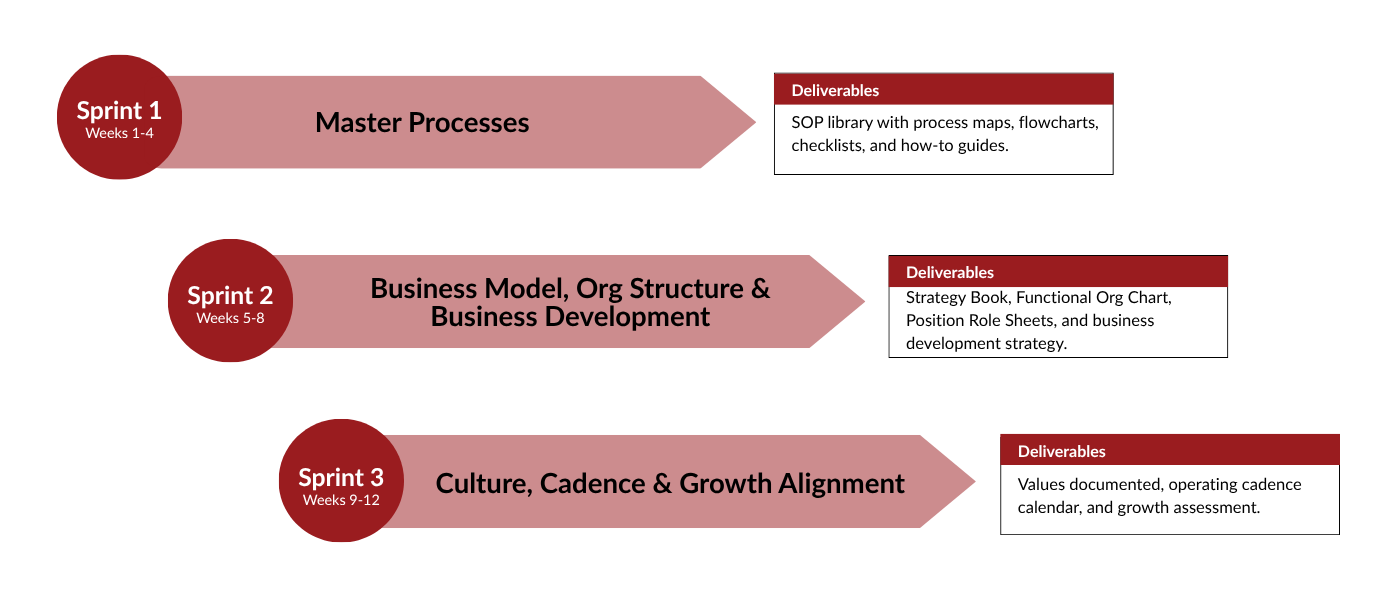
Sprint 1: Master Processes (Weeks 1–4)
Goal: Convert tribal knowledge into scalable, trainable assets before it walks out the door.
Key Activities: Seller knowledge extraction workshops, shadowing, collaborative documentation.
Primary Deliverable: A complete SOP library covering the top 10-20 critical processes—including process maps, flowcharts, checklists, how-to guides, and responsibility assignments.
Outcome: The business no longer depends on any single person’s memory. New employees can be onboarded faster and more consistently. Quality and efficiency improve immediately. Buyer has a starting place for future improvements.
Sprint 2: Business Model, Org Clarity & Business Development (Weeks 5–8)
Goal: See the business clearly—who does what, what actually makes money, and how growth is generated.
Key Focus Areas:
Revenue Groups/Circles, Offerings, and Customer Segments (with gross margin visibility) document Business Model.
Functional Org Chart
Position Role Sheets provide organizational structure clarity.
Business Development Structure: Marketing plan & structure, Sales structure & pipeline, Customer Service structure creates repeatable biz dev outcomes.
Primary Deliverable: A Strategy Book capturing findings, plus the Org Chart, Role Sheets, and Biz Dev structures.
Outcome: You understand the true economics of the business and can make confident decisions. Roles are clear, increasing employee engagement, staff stability, and visibility to future hiring. and. Business development has a repeatable structure instead of relying on the owner’s heroic efforts.
Sprint 3: Culture, Cadence & Growth Alignment (Weeks 9–12)
Goal: Align the human elements and set a clear, stage-appropriate direction for the future.
Key Focus Areas:
Brand Values + Core Values: Identification, definition, alignment, and rollout plan
Meeting Structure: Identify key meetings and cadence; install effective meeting models and templates; launch One-to-One process (including first two rounds)
Growth Roadmap: Stage-of-Growth assessment, identify misalignments and top priorities, align to proven growth rules and checklist
Primary Deliverables: Company Values, 90-day operating cadence calendar, Stage Rules Compliance report, and Growth Roadmap.
Outcome: A team united around shared values. Issues surface early through structured communication. You have a clear picture of where the business stands today and exactly what to prioritize next—without overreaching or stalling growth.
Program Close: A Transition Readiness Certificate summarizing all assets created, risks mitigated, open items with owners, and recommended focus areas for the second 90 days.
The Weekly Rhythm That Creates Calm
Three 2-hour meetings per week (with flexibility to meet buyer’s needs) over 12 weeks — total ~72 in-person hours.
Balanced mix of: standing owner meetings, team working sessions, and front-loaded seller knowledge extraction.
Weekly deliverables from each meeting.
End-of-sprint status updates with clear open items and responsibilities.
Ongoing progress dashboard tracking artifact completion and risk log.
This isn’t endless meetings for meeting’s sake. Every session has a purpose and produces usable output.
Who the ReWild Transition System Is For

Primary Audience: First-time buyers and Entrepreneurship Through Acquisition (ETA) entrepreneurs acquiring established Stage 2–3 companies. Often SBA- or bank-financed. They have significant capital and reputation at risk and need operational stability fast.
Secondary Audiences Who Benefit or Co-Fund:
Sellers who want a smoother exit, protected legacy, and higher certainty of close.
Business brokers and M&A advisors who want to differentiate quality listings, close faster, and reduce retrade risk.
Lenders (SBA and partner banks) looking to lower post-close default risk.
Search fund investors, independent sponsors, and ETA accelerators protecting their equity.
It creates genuine win-win economics across the deal ecosystem.
General Advice: How to Give Your Acquisition the Best Chance of Success
Whether or not you use a formal system like ReWild, here are battle-tested principles that dramatically improve outcomes in the first 90 days:
Front-load knowledge transfer while the seller is still motivated and present. The window closes fast once the deal is done and emotions shift.
Document the “how,” not just the “what.” Process maps, checklists, and decision trees turn individual expertise into organizational capability.
Clarify roles and accountability immediately. Ambiguity breeds confusion, shadow orgs, and resentment. A clear functional org chart + position role sheets changes everything.
Understand your real unit economics before making changes. Many new owners accidentally damage the most profitable parts of the business because they didn’t have clear visibility into margins by offering and segment.
Install communication rhythms early. Regular, structured 1:1s and team meetings surface problems while they’re still small and build trust.
Align on values and direction. Culture doesn’t “just happen.” Define what matters, get alignment, and use it as a decision filter.
Don’t try to wing the transition while also running the business. The cognitive and emotional load is enormous. A structured system reduces that load dramatically.
The buyers who thrive treat the first 90 days as a dedicated integration and installation project—not something that happens in the margins of “real work.”
A Modest Investment Relative to the Risk
The ReWild Transition System is priced with downside protection in mind. For a $2M–$10M+ acquisition, even a small operational miss or value leak can far exceed the program cost. Pricing is tiered by company size/complexity (Up to 50 employees: $35,000; 51–100 employees: $50,000) with flexible payment terms: 50% at close, 25% at week 5, 25% at week 10.
Optional add-ons include Pre-Close preparation (2 weeks) and Keep the Momentum support for the second 90 days.
Ready to Make Your First 90 Days Predictably Successful?

If you’re in the process of acquiring a business—or have recently closed—the ReWild Transition System can be the difference between a stressful scramble and a calm, confident start that protects your investment and sets up long-term success.
Make the first 90 days decisively boring. Your future self (and your bank) will thank you.
Ready to explore whether the ReWild Transition System is the right fit for your situation? Reach out to schedule a conversation. We’ll help you assess your specific transition risks and opportunities.
About ReWild
The ReWild Group helps buyers, sellers, and lenders de-risk small business transitions through structured operating systems, knowledge capture, and alignment frameworks. Our programs turn the highest-risk period of ownership into the most predictable.
This post is for informational and educational purposes. Individual results depend on many factors. The ReWild Transition System is a structured service offering with defined deliverables and is not a guarantee of business performance.