Small Business Growth Stages: How to Know Exactly Where You Are (and What to Do Next)
If you’re like most small business owners we work with, you’ve probably had this thought: Revenue is growing… but why does it feel more chaotic and exhausting than ever?
You’re not imagining it. Growth isn’t linear. The rules that helped you get from 5 to 15 employees are often the very things holding you back at 40 or 80. The good news? There’s a proven roadmap that takes the guesswork out of scaling.
At The ReWild Group, we’ve spent over 30 years studying more than 1,500 small and mid-sized businesses. What emerged is Organizational ReWilding®—a research-backed framework based on how healthy ecosystems (and healthy businesses) actually grow. At its foundation are the 7 Stages of Growth, organized primarily by employee count but defined by much more: the challenges, leadership needs, systems, and “infusions” required at each phase.
Today, we’ll walk you through these stages so you can pinpoint exactly where your business is—and what to focus on next.
Why Most Small Business Growth Models Fall Short
Traditional models (like the classic Churchill & Lewis stages) give a high-level view, but they often lack the practical, stage-specific rules owners need when they’re in the trenches. Organizational ReWilding goes deeper by examining multiple dimensions—Gates of Focus, Builder-Protector Ratio, Modality, Leadership Style Blend, and more—so you’re not just surviving the next stage… you’re building something resilient and profitable.
Let’s break down the stages.
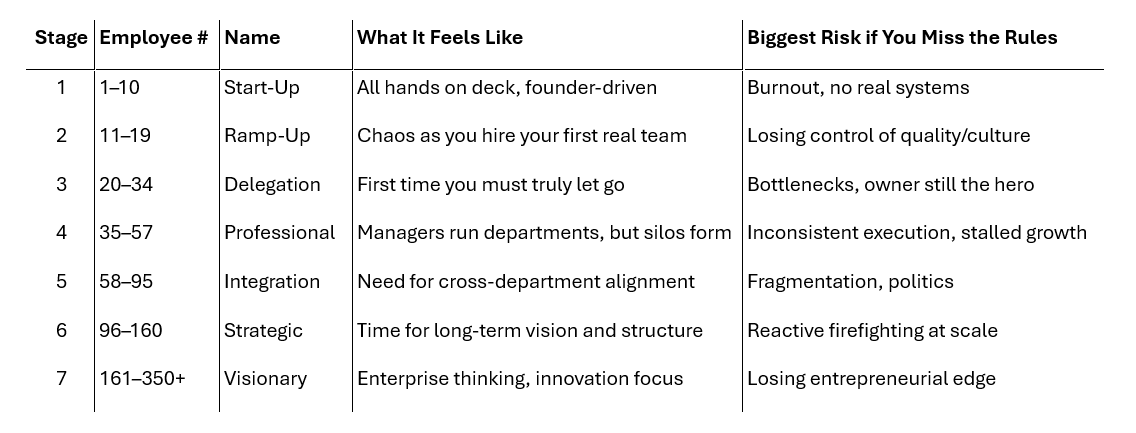
The 7 Stages of Growth at a Glance
How to Identify Your Current Stage (Quick Self-Assessment)
Answer these questions honestly:
How many full-time equivalent employees do you have?
Are you still the primary decision-maker for day-to-day operations?
Do departments or teams operate with clear accountability, or do issues keep coming back to you?
Is your leadership team proactive or mostly reactive?
Are you spending most of your time on strategy/vision… or still in the weeds?
If you’re between 20–57 employees (Stages 3 & 4), you’re in one of the most common “make-or-break” zones for small businesses. Many owners we talk to feel stuck here—growth is happening, but freedom and profitability aren’t.
What Changes—and What You Must Do—at Each Key Transition
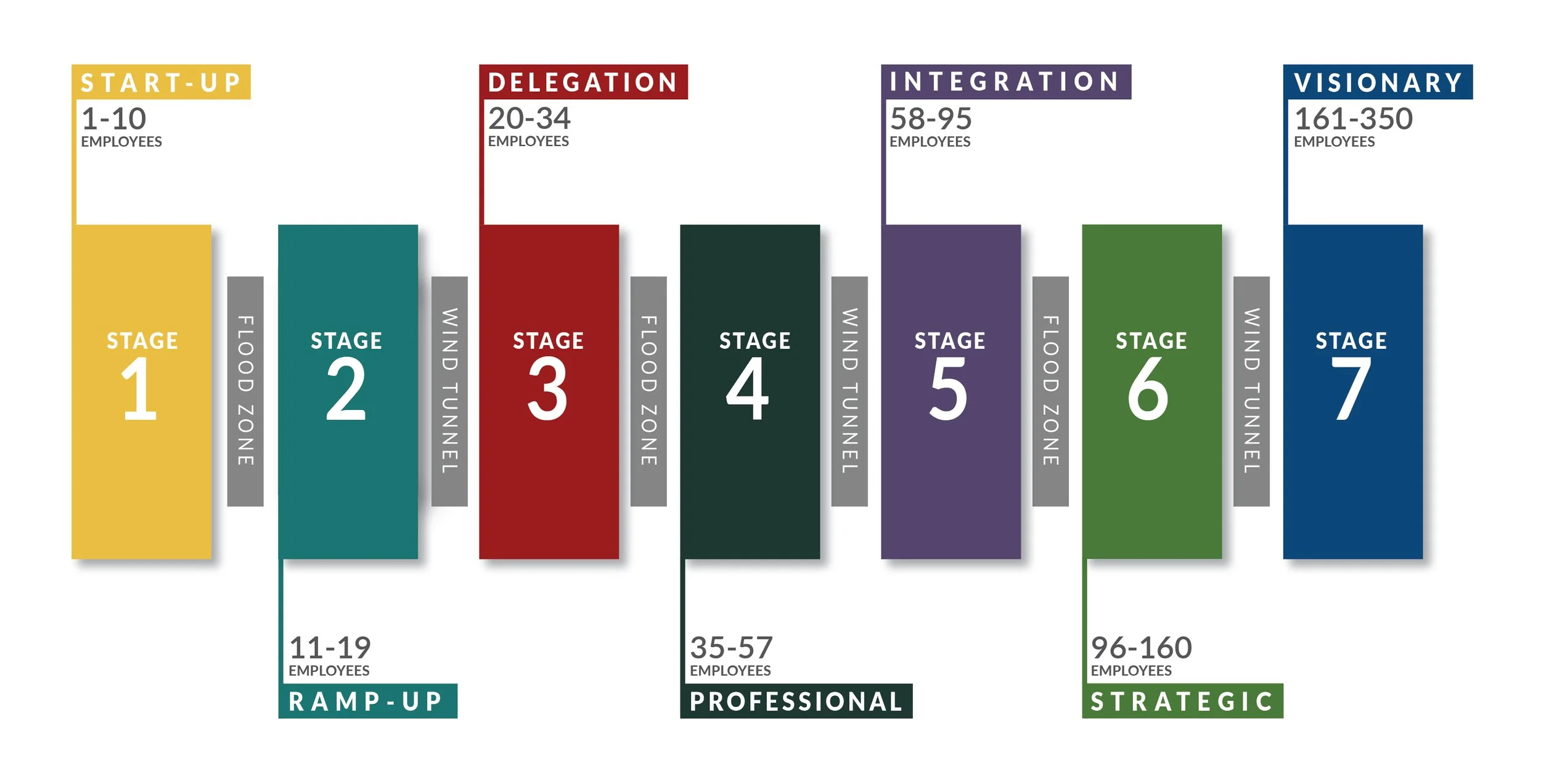
Stages 1–2 (Start-Up & Ramp-Up): Focus on survival, cash flow, and delivering consistently. The founder wears every hat.
Stage 3 – Delegation (20-34 employees): This is where you must shift from doing to leading through others. Key infusion: Strong delegation systems and trust in your team. Without it, you stay the bottleneck.
Stage 4 – Professional (35-57 employees): A professional management team becomes essential. Departments need real structure, processes, and accountability. This stage is often where owners first feel “I can’t keep up with all the details anymore”—a signal it’s time to professionalize.
Stages 5–6 (Integration & Strategic): Cross-functional alignment and forward-looking strategy take center stage. You move from tactical management to building a true enterprise.
Stage 7 – Visionary: You focus on innovation, culture at scale, and long-term industry impact.
The Organizational ReWilding Advantage
What makes this framework different is that it treats your business like a living ecosystem. You don’t just add processes—you infuse the missing elements (leadership balance, systems, culture) that create natural resilience and growth.
Every stage has:
Non-Negotiable Rules you must follow
Classic Challenges to anticipate
Elements of an Exceptional Business to strengthen
Owners who apply these rules report greater clarity, reduced personal dependency, higher profitability, and the ability to step back without everything falling apart.
Your Next Steps – No Matter Your Stage
Determine your stage using the employee count and self-assessment above.
Read the corresponding 60-minute guidebook for your stage (each one distills the exact rules, challenges, and actions).
Run a quick diagnostic. We offer a free Growth Readiness Check that gives you personalized insights.
Focus on one key infusion. Don’t try to fix everything at once. Pick the highest-leverage shift for your current stage.
Growth doesn’t have to mean more stress. When you understand the natural stages and apply the right rules at the right time, scaling becomes more predictable, profitable, and—yes—more enjoyable.
Ready to Move to the Next Stage with Confidence?
If you’re feeling the friction of growth and want a clear roadmap tailored to your business, we’re here to help. Our guidebooks, workshops, and coaching are built specifically for small and mid-sized business owners who want to build something exceptional—without sacrificing their life in the process.
Schedule your free Growth Readiness Check today and take the first step toward a business that works for you.