Making Sense of the SMB Framework Landscape
Small and mid-sized businesses rarely struggle because of effort. More often, they struggle because growth introduces complexity faster than the organization’s internal systems can absorb it.
That’s where structured business frameworks come in.
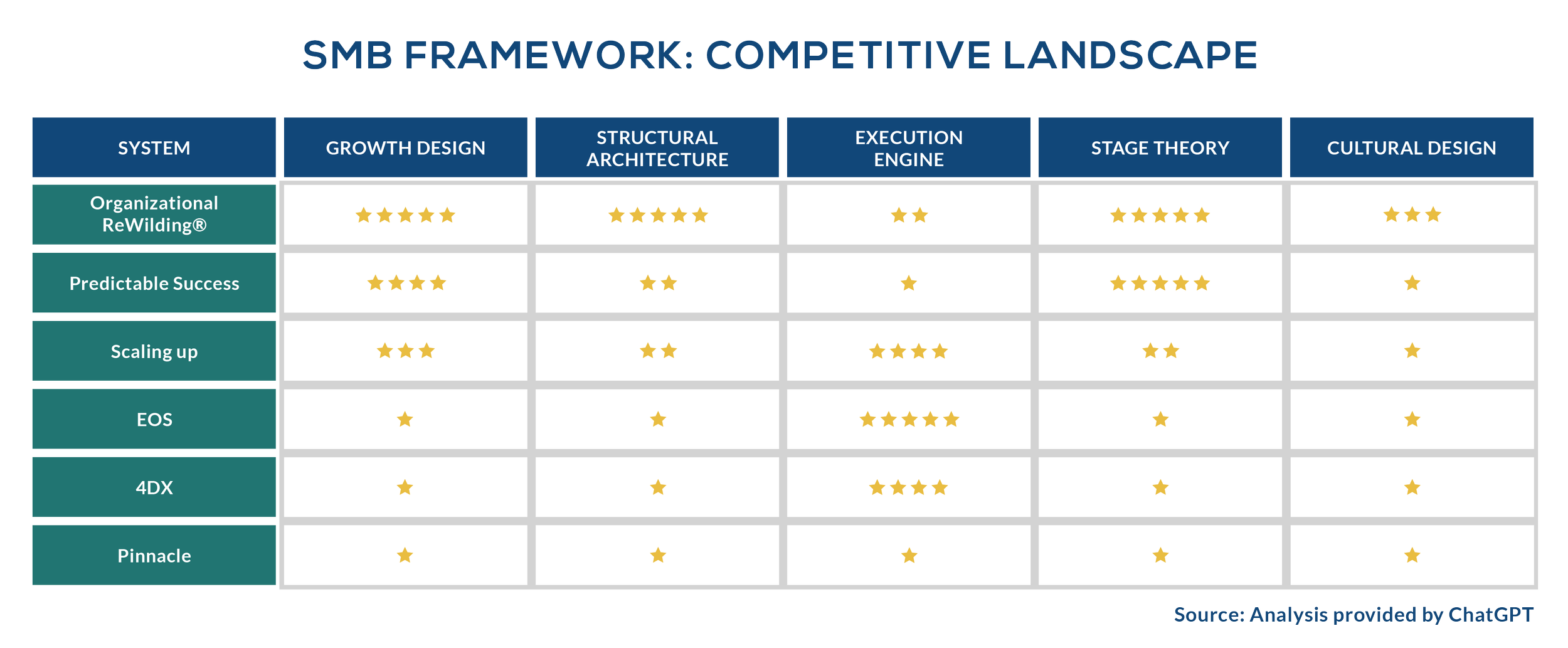
The chart above presents a comparative analysis of several widely used SMB growth systems across five critical design dimensions:
Growth Design – Does the framework provide a clear model for scaling the business?
Structural Architecture – Does it help define roles, responsibilities, and accountability?
Execution Engine – Does it include mechanisms for driving consistent follow-through?
Stage Theory – Does it adapt based on the company’s size and developmental stage?
Cultural Design – Does it intentionally shape leadership behavior and team norms?
Each of the frameworks included—Predictable Success, Scaling Up, EOS, 4DX, and Pinnacle—has created meaningful value for SMB leaders by helping translate ambition into operational discipline.
Where Each Framework Excels
Predictable Success offers one of the strongest stage-based growth models available. Its ability to help leaders identify where their organization sits within the lifecycle of business development is particularly valuable for companies navigating founder-dependence or early operational drift.
Scaling Up provides robust tools for execution and alignment. Many teams benefit from its practical emphasis on priorities, KPIs, and meeting rhythms, especially once functional departments begin to emerge.
EOS (Entrepreneurial Operating System) has become one of the most widely adopted execution frameworks in the SMB market. Its simplicity and cadence-based accountability structures help teams establish clarity around quarterly priorities and ownership.
4DX (The 4 Disciplines of Execution) brings a powerful behavioral lens to performance management. Its focus on lead measures and visible scoreboards makes it especially useful for driving change initiatives that require consistent team engagement.
Pinnacle offers an integrated operating model that blends strategic planning with leadership development—an approach that resonates strongly with organizations seeking structure without excessive rigidity.
Every one of these systems can create tangible improvement when applied consistently.
Why Organizational ReWilding Scores Highly
Organizational ReWilding® was designed to address a common constraint that emerges as SMBs grow: the gradual erosion of managerial effectiveness as complexity increases.
Unlike frameworks that focus primarily on planning cadence or KPI tracking, Organizational ReWilding emphasizes:
Managerial Role Design
Helping leaders understand not just what should get done—but who should own decision rights as the business evolves.Structural Integrity
Clarifying how authority, accountability, and information flow should change from one stage of growth to the next.Stage-Appropriate Leadership Expectations
Aligning leadership behavior with the organization’s current level of operational maturity.Cultural Reinforcement Through Structure
Embedding collaboration, ownership, and cross-functional alignment directly into reporting relationships and management processes.
Because of this systems-level orientation, Organizational ReWilding tends to score highly in:
Growth Design
Structural Architecture
Stage Theory
Cultural Design
These are the domains that determine whether progress made through planning and execution can actually be sustained over time.
Understanding the “Execution Engine” Rating
You’ll notice that Organizational ReWilding receives a lower score in the Execution Engine category.
This is intentional.
Organizational ReWilding is not designed to function as a standalone execution methodology in the way that EOS or 4DX might. Instead, it is meant to be implemented in partnership with a Certified Organizational ReWilding Adviser (CORA).
A CORA works directly with the leadership team to:
Interpret structural insights in real-time
Facilitate role and responsibility transitions
Support delegation and managerial capability development
Ensure that stage-appropriate systems are adopted and maintained
In practice, the CORA provides the implementation bridge—bringing contextual experience and hands-on guidance that helps translate structural design into day-to-day managerial behavior.
This human layer is what closes the gap between insight and execution.
The Bigger Picture
The most important takeaway from this comparison isn’t which framework is “best.”
It’s that growing businesses benefit from using any well-defined framework to bring clarity, consistency, and intentionality to how they operate.
Execution systems help teams move faster.
Strategic planning tools improve alignment.
Lifecycle models reduce blind spots.
And structural frameworks—like Organizational ReWilding—ensure that as the business grows, leadership capacity grows with it.
For many SMBs, the greatest long-term gains come not from choosing one approach over another, but from understanding how structural design, execution discipline, and leadership development can work together to support sustainable growth.
Organizational ReWilding exists to make that integration possible.